Sign In

  • Forgot your password?
  • Need a new account?

Register


Independent Pillar Pneumatic Optical Table(Pendulum Rod) | SIMTRUM Photonics Store

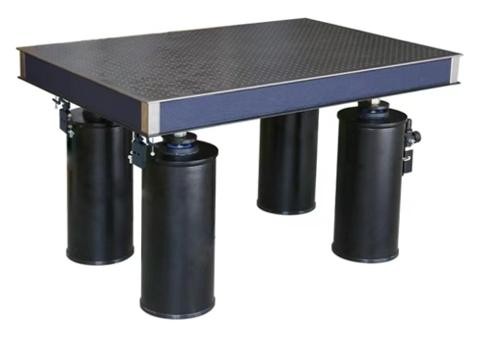
Independent Pillar Pneumatic Optical Table(Pendulum Rod)
OM-Independent Pneumatic.jpg

Pneumatic Optical Table with Independent Support Pillars

    The SIMTRUM Pneumatic Optical Table with independent support pillars is engineered specifically for high-precision applications. Utilizing an advanced trifilar vibration isolation system integrated with a four-point or six-point independent pneumatic pillar configuration, it achieves exceptional low-frequency stability. The system exhibits a vertical natural frequency as low as 1.0–1.7 Hz and a horizontal natural frequency as low as 1.0–1.5 Hz, consistently maintaining a vibration isolation efficiency of over 90%–95% at 10 Hz.

    While maintaining a surface roughness of <0.6 μm and a flatness of 0.05–0.1 mm/m², the platform supports a working payload of up to 1500 kg. Operating at a standard pressure of 0.3–0.4 MPa, the system effectively filters out environmental disturbances. The tabletop employs a standard honeycomb optical breadboard architecture, offering superior thermal stability. The surface features a matte textured finish to minimize reflections. With a thickness of 50 mm, the breadboard is equipped with a standard M6 through-hole threaded array (25 mm pitch and 37.5 mm margin), facilitating the seamless installation of optoelectronic components.

    For specific technical specifications or custom requirements, please contact our sales team. We offer complete customization of tabletop dimensions, thickness, and mounting hole patterns (e.g., M6 or 1/4-20) to ensure seamless integration with your laboratory space and instrumentation.


Technical Specifications Table

Parameter Specifications
Available Dimensions 600mm × 600mm to 10000mm × 2000mm (Customizable)
Tabletop Thickness 50 / 100 / 200 / 300 mm (Customizable)
Total System Height 800 mm
Standard Top Plate Material SUS430 (1Cr17) GB-grade high-permeability stainless steel, plate thickness ≥ 6 mm
Isolation Method Pneumatic Damping + Trifilar Pendulum Isolation System
Natural Frequency (Vertical) 1.0 ~ 1.7 Hz
Natural Frequency (Horizontal) 1.0 ~ 1.5 Hz
Isolation Efficiency (Vertical) 90% ~ 95% at 10Hz
Isolation Efficiency (Horizontal) 90% ~ 95% at 10Hz
Surface Flatness ≤ 0.02 ~ 0.05 mm/㎡
Surface Roughness ≤ 0.6 μm
Mounting Hole Specification M6 (Customizable)
Hole Pitch 25 × 25 mm (Customizable)
Border Margin 37.5 mm (Customizable)
Payload Capacity 4 supports: 1000 kg; 6 supports: 1500 kg
Operating Pressure Range Max 0.7 MPa / Recommended 0.3 ~ 0.4 MPa
Tabletop Mass Density 50mm: ~110kg/m²; 100mm: ~120kg/m²; 150mm: ~130kg/m²;
200mm: ~140kg/m²; 300mm: ~165kg/m²


Definition of Vibration Standards

The vibration isolation performance of an optical table is typically quantified by a specific set of vibration criterion curves. Given that precision instruments across various disciplines exhibit varying sensitivities to environmental disturbances, Vibration Criterion (VC) Curves are universally adopted within the industry as the standard for evaluation.

The standard vibration levels for VC curves include: Workshop (ISO), Office (ISO), Residential Day (ISO), Op. Theatre (ISO), VC-A, VC-B, VC-C, VC-D, VC-E, VC-F, VC-G, NIST-A, NIST-A1, VC-H, VC-I, VC-J, VC-K, VC-L, and VC-M. These 19 curves have become internationally recognized benchmarks for seismic and vibration isolation grading. Descriptions of common vibration isolation levels are detailed in the table below:

Criterion Level RMS Velocity[1] (μm/s) RMS Velocity (μin/s) Detail Size[2] (μm) Application Description
Workshop (ISO) 800 32,000 N/A Distinct vibration; workshops and non-sensitive areas.
Office (ISO) 400 16,000 N/A Perceptible vibration; offices and non-sensitive areas.
Residential Day (ISO) 200 8,000 75 Barely perceptible; sleep areas, microscopy (<40×).
Op. Theatre (ISO) 100 4,000 25 Imperceptible; operating theaters, microscopy (<100×).
VC-A 50 2,000 8 Optical microscopy up to 400×, microbalances.
VC-B 25 1,000 3 3 μm linewidth inspection, photolithography (including steppers).
VC-C 12.5 500 1–3 1000× microscopy, TFT-LCD scanners, electron microscopy.
VC-D 6.25 250 0.1–0.3 TEM/SEM, electron beam systems, and highly demanding equipment.
VC-E 3.12 125 N/A Long-path lasers, nanoscale e-beam lithography, ultra-stable systems.
VC-F 1.56 62.5 N/A Extremely quiet research spaces; not typically used as a design standard.
VC-G 0.78 31.3 N/A Ultra-quiet research spaces; difficult to achieve and not recommended for design standards.

Note 1: Measurements are conducted in one-third octave bands over the frequency range of 8 to 80 Hz (VC-A and VC-B) or 1 to 80 Hz (VC-C through VC-G).
Note 2: "Detail Size" refers to linewidths in microelectronics manufacturing or particle sizes in medical/pharmaceutical research. It does not pertain to imaging in probe-based technologies, AFM, or nanotechnology.

Regarding optical tables, standard damped isolation platforms can achieve VC-B compliance, standard pneumatic isolation platforms can reach VC-C, certain pendulum-type isolators can achieve VC-D, and active isolation platforms can meet the extremely high VC-E/VC-F standards.

You may refer to the table above to select the appropriate product series based on your experimental precision requirements.


Optical tables serve as the "cornerstone of scientific research" in modern precision science.

Whether in precision laser experiments, ultrafast spectroscopy, quantum computing, or semiconductor metrology, any minute environmental disturbance—such as foot traffic, HVAC airflows, or structural oscillations—can lead to experimental data invalidation or image blurring. As a high-precision vibration control platform, it not only provides a rigid and planar physical surface for optical components but also utilizes its support system to isolate the experimental setup from complex floor-borne noise.

Mathematical Modeling of Vibration Isolation

The support system of an optical table is typically modeled as a Damped Simple Harmonic Oscillator. Its dynamic equation of motion follows Newton’s Second Law and is expressed as:

The system's performance is characterized by its natural frequency ($f_n$), which determines the onset of isolation:

According to vibration transmissibility theory, the system enters the isolation region when the excitation frequency $f$ exceeds $\sqrt{2}$ times the natural frequency $f_n$. In this regime, the surface energy attenuates rapidly as frequency increases; thus, the optical table effectively functions as a mechanical low-pass filter.

Classification of Passive Isolation Platforms

Passive vibration isolation platforms are categorized into three primary versions based on their damping mechanisms, each suited for specific laboratory environments:

  • Solid Vibration Isolation (Rigid Support)
    The most fundamental rigid support system, utilizing composite rubber damping pads embedded within the support legs to dissipate energy. It offers extreme structural stability, high load capacity, and low maintenance. Its natural frequency is relatively high (typically 6-10 Hz), primarily targeting high-frequency vibrations.
  • Pneumatic Optical Table (Air Spring)
    Supported by air springs filled with compressed air. Due to the compressibility of air, the system maintains a very low spring constant, reducing the natural frequency to 1.0-2.0 Hz. These are typically equipped with automatic leveling valves to ensure precise planarity.
    Pneumatic Isolation System Structure

    Fig 1. Schematic of Pneumatic Vibration Isolator Structure

  • Pneumatic with Pendulum Rod (High-End Passive)
    This represents the state-of-the-art in passive isolation, integrating simple and trifilar pendulum structures into the pneumatic system to convert horizontal displacement into oscillatory motion:
    • Horizontal Decoupling: The horizontal isolation frequency depends solely on the pendulum length, allowing the system to "glide" over floor sway with minimal resistance.
    • Trifilar Pendulum System: Symmetrically distributed suspension wires (at 120°) provide superior rotational stiffness, effectively suppressing torsional modes.

    This design pushes the horizontal natural frequency down to 1.0 Hz or lower, completely resolving the coupling between horizontal and vertical vibrations.

    Trifilar Pendulum Isolation Structure

    Fig 2. Schematic of Trifilar Pendulum Isolation System Structure

Active Vibration Isolation

Active isolation systems feature integrated high-sensitivity vibration sensors and electromagnetic actuators. A controller generates an "inverse force signal" to actively cancel out incoming disturbances.

  • Settling Time: By eliminating the resonance amplification zone, the system significantly reduces settling time.
  • Sub-Hertz Mitigation: It suppresses extremely low-frequency vibrations beyond the reach of passive systems, making it ideal for instruments requiring ultimate stability, such as Atomic Force Microscopes (AFM).


Search Reset
Compare Model Drawings & Specs Availability Reference Price
(USD)
OM-OT-IPP-06-06-01
600×600×100mm Optical Table, M6 tapped holes with 50mm hole grid
4-6 Weeks Request for quote
OM-OT-IPP-09-06-01
900×600×100mm Optical Table, M6 tapped holes with 50mm hole grid
4-6 Weeks Request for quote
OM-OT-IPP-10-08-01
1000×800×100mm Optical Table, M6 tapped holes with 50mm hole grid
4-6 Weeks Request for quote
OM-OT-IPP-10-10-01
1000×1000×100mm Optical Table, M6 tapped holes with 50mm hole grid
4-6 Weeks Request for quote
OM-OT-IPP-12-06-01
1200×600×100mm Optical Table, M6 tapped holes with 50mm hole grid
4-6 Weeks Request for quote
OM-OT-IPP-12-08-01
1200×800×100mm Optical Table, M6 tapped holes with 50mm hole grid
4-6 Weeks Request for quote
OM-OT-IPP-12-09-01
1200×900×100mm Optical Table, M6 tapped holes with 50mm hole grid
4-6 Weeks Request for quote
OM-OT-IPP-12-12-01
1200×1200×100mm Optical Table, M6 tapped holes with 50mm hole grid
4-6 Weeks Request for quote
OM-OT-IPP-15-09-02
1500×900×200mm Optical Table, M6 tapped holes with 50mm hole grid
4-6 Weeks Request for quote
OM-OT-IPP-15-10-02
1500×1000×200mm Optical Table, M6 tapped holes with 50mm hole grid
4-6 Weeks Request for quote
OM-OT-IPP-15-12-02
1500×1200×200mm Optical Table, M6 tapped holes with 50mm hole grid
4-6 Weeks Request for quote
OM-OT-IPP-18-09-02
1800×900×200mm Optical Table, M6 tapped holes with 50mm hole grid
4-6 Weeks Request for quote
OM-OT-IPP-20-10-02
2000×1000×200mm Optical Table, M6 tapped holes with 50mm hole grid
4-6 Weeks Request for quote
OM-OT-IPP-20-12-02
2000×1200×200mm Optical Table, M6 tapped holes with 50mm hole grid
4-6 Weeks Request for quote
OM-OT-IPP-20-15-02
2000×1500×200mm Optical Table, M6 tapped holes with 50mm hole grid
4-6 Weeks Request for quote
OM-OT-IPP-24-18-02
2400×1800×200mm Optical Table, M6 tapped holes with 50mm hole grid
4-6 Weeks Request for quote
OM-OT-IPP-30-12-03
3000×1200×300mm Optical Table, M6 tapped holes with 50mm hole grid
4-6 Weeks Request for quote

OM-OT-IPP-30-12-03 - Parameter

OM-OT-IPP-24-18-02 - Parameter

OM-OT-IPP-20-15-02 - Parameter

OM-OT-IPP-20-12-02 - Parameter

OM-OT-IPP-20-10-02 - Parameter

OM-OT-IPP-18-09-02 - Parameter

OM-OT-IPP-15-12-02 - Parameter

OM-OT-IPP-15-10-02 - Parameter

OM-OT-IPP-15-09-02 - Parameter

OM-OT-IPP-12-12-01 - Parameter

OM-OT-IPP-12-09-01 - Parameter

OM-OT-IPP-12-08-01 - Parameter

OM-OT-IPP-12-06-01 - Parameter

OM-OT-IPP-10-10-01 - Parameter

OM-OT-IPP-10-08-01 - Parameter

OM-OT-IPP-09-06-01 - Parameter

OM-OT-IPP-06-06-01 - Parameter

OM-OT-IPP-30-12-03 - Download

OM-OT-IPP-24-18-02 - Download

OM-OT-IPP-20-15-02 - Download

OM-OT-IPP-20-12-02 - Download

OM-OT-IPP-20-10-02 - Download

OM-OT-IPP-18-09-02 - Download

OM-OT-IPP-15-12-02 - Download

OM-OT-IPP-15-10-02 - Download

OM-OT-IPP-15-09-02 - Download

OM-OT-IPP-12-12-01 - Download

OM-OT-IPP-12-09-01 - Download

OM-OT-IPP-12-08-01 - Download

OM-OT-IPP-12-06-01 - Download

OM-OT-IPP-10-10-01 - Download

OM-OT-IPP-10-08-01 - Download

OM-OT-IPP-09-06-01 - Download

OM-OT-IPP-06-06-01 - Download

Accessories

Compare Model Drawings & Specs Availability Reference Price
(USD)