Sign In

  • Forgot your password?
  • Need a new account?

Register


Narrowband Tunable Filter | SIMTRUM Photonics Store

Narrowband Tunable Filter

SIMTRUM's NTF Narrowband Tunable Filter - NM (or NE) is a dual-port fiber-optic device based on a free-space optics platform combined with diffraction grating technology. Its primary function is to precisely select a specific target band from the input broadband optical spectrum for output, while suppressing other wavelength bands. When a broadband optical signal is injected from the input port, the internal diffraction grating disperses the light.


Through optical design, a Gaussian-shaped transmission spectrum is ultimately formed at the output, achieving narrowband filtering. We offer a variety of bandwidth and tuning range options. The operating wavelength range covers the 780-1000nm, X, O, S, C, and L bands, meeting the needs of diverse applications.

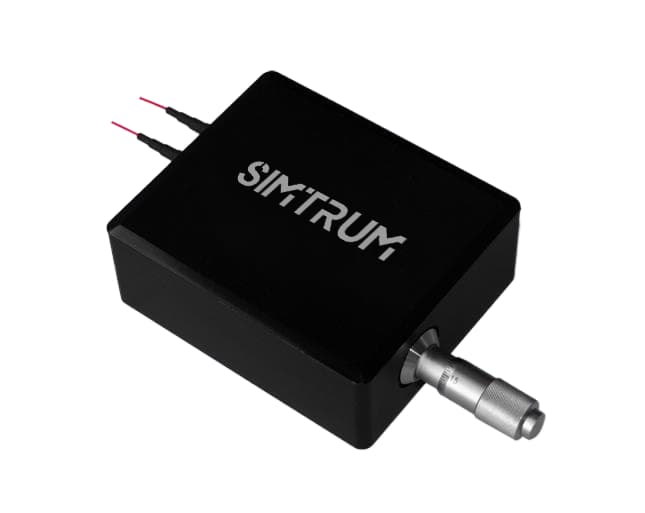
Manual Version of NTF-NM-P

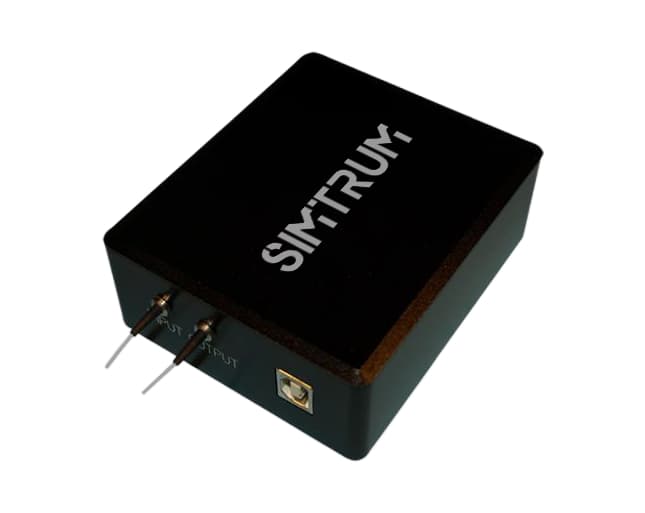
Electric Version of NTF-NE-S

Features

  • Tuning range up to 200nm, covering the broad 1000-1700nm band
  • Bandwidth as narrow as 0.1nm
  • Low insertion loss and low polarization-dependent loss
  • High optical power handling capability
  • Precise and uniform bandwidth across the entire tuning range
  • High out-of-band rejection

Applications

  • DWDM channel filtering
  • WDM system wavelength tuning
  • ASE noise suppression
  • Pulse shaping
  • FBG sensor demodulation
  • Tunable fiber lasers

Characteristic curve

Typical Transmission Spectra of 0.07nm Tunable Filter Centred at 950nm

Typical Spectra & Tuning Feature of 0.15nm FWHM Tunable Filter over 830-950nm


Typical Transmission Spectrum and Tuning Dispersion of 0.25nm Filter over X-Band
 
Typical Transmission Spectrum and Tuning Dispersion of 0.18nm Filter over O-Band
 
Typical Transmission Spectrum and Tuning Dispersion of 0.15nm Filter over S/C/L-Band
Size
 
OE-NTF-NM-S
 
 
OE-NTF-NM-P
 
 
OE-NTF-NE-S

Specifications NTF-NM-S/P-810(Manual) NTF-NE-S/P-810 (Electric)
Central Wavelength 810nm, 880nm, 940nm or as specified (within 810-960nm range)
Tuning Range 60nm or 120nm S-version: 60nm
P-version: 120nm
Insertion Loss 2.5dB typ., 3.5dB max. (connector exclusive)
FWHM Bandwidth 1.00nm to 0.07nm or as specified
Wavelength Resolution 0.02nm S-version: 0.01nm
P-version: 0.001nm
Wavelength Repeatability ±0.02nm S-version: ±0.01nm
P-version: ±0.005nm
Max. Tuning Speed Not Applicable 40nm/sec
Polarization Dependent Loss 0.15dB typ., 0.30dB max. (SM fiber only)
Extinction Ratio 20dB (Connector exclusive, PM fiber only)
Bandwidth Ratio (3/20/30dB) ~1/2.5/3.5
Out-of-Band Suppression >45dB (Transmission peak to average background)
Max. Optical Power 300mW (CW), High-power version up to 2.0W available upon request
Return Loss >45dB
Polarization Mode Dispersion <0.2ps (SM fiber only)
Group Delay <0.1ps/nm
Pigtail Fiber Type SM fiber or PM fiber (e.g., Nufern 780HP, Panda PM 850)
Electrical Interface Not Applicable USB
Operating Temperature 10°C to 50°C
Storage Temperature -10°C to 75°C
Weight <0.5kg (typical)
Other RoHS Compliant


Specification NTF-NM-S/P-1045(Manual) NTF-NE-S/P-1045 (Electric)
Center Wavelength 1060nm±15nm, 1310nm±15nm, 1550nm±20nm, 1600nm±20nm
Tuning Range 1060nm: 60/120nm
1310nm: 60/120nm
1550nm: 60/140nm
1600nm: 60/140nm
1060nm: 40/80nm
1310nm: 45/95nm
1550nm: 50/110nm
1600nm: 50/110nm
Insertion Loss Typ. 1.5dB, Max. 2.5dB(60nm)/3.0dB(120nm) (connector exclusive)
FWHM Bandwidth Various options from 0.075nm to 2.50nm available for different bands
Wavelength Resolution 0.02nm 0.01nm
Wavelength Repeatability ±0.02nm ±0.01nm
Max. Tuning Speed Not Applicable 40nm/sec
Polarization Dependent Loss Typ. 0.08dB/Max. 0.15dB(60nm)
Typ. 0.15dB/Max. 0.30dB(120nm) (SM fiber only)
Extinction Ratio 20dB (connector exclusive, PM fiber only)
Spectral Shape Gaussian
Bandwidth Ratio (3/20/30dB) ~1/2.5/3.5
Bandwidth Variation ±4%(60nm) and ±6%(120nm)
Max. Optical Power 500mW (CW), high-power version up to 5.0W available
Return Loss >45dB
Out-of-Band Suppression >45dB (transmission peak to average background)
Polarization Mode Dispersion <0.2ps (SM fiber only)
Group Delay <0.1ps/nm
Pigtail Fiber Type HI1060, SMF-28, SMF-28e
Panda PM980, PM1300, PM1550
Electrical Interface Not Applicable USB(standard), I²C, SPI, RS232
Power Consumption Not Applicable <0.5W (CW)
Operating Temperature 10°C to 50°C
Storage Temperature -10°C to 75°C
Other RoHS Compliant
  • Tuning range up to 200nm available on request
  • Polarization-maintaining (PM) fibers are aligned with the slow axis by default (blocking the fast axis), but can be adjusted according to specified requirements.
  • The primary differences between the S-version and P-version lie in the tuning range, wavelength resolution, and wavelength repeatability. The P-version offers a wider tuning range, higher wavelength resolution, and superior wavelength repeatability. Therefore, if your application has stringent requirements for wavelength accuracy, stability, and repeatability, please select the P-version. If your priorities are tuning speed and range, and the demands for absolute accuracy and repeatability are less critical, the S-version is recommended.
 A. Version Type P (P-version, for pigtail or receptacle interfaces)
S (S-version, for pigtail version only)
 B. Center Wavelength e.g., 1550 (for 1550nm)
e.g., 1310 (for 1310nm)
 C. Tuning Wavelength Range e.g., 60 (for 60nm)
e.g., 120 (for 120nm)
 D. FWHM Bandwidth e.g., 0.5 (for 0.5nm)
 E. Fibre Type SM (Single Mode Fiber)
PM (Panda PM Fiber)
Others (e.g., LMA, PLMA)
 F. Cable Diameter 0.25 (250µm OD buffer)
0.9 (900µm OD loose tube)
3.0 (3.0mm OD cable)
Only for pigtail version
 G. Cable Length e.g., 0.5 (for 0.5m)
e.g., 1.0 (for 1.0m)
Only for pigtail version
 H. Connector Type e.g., FC/APC, FC/UPC, SC/APC, LU/UPC
00 (No Connector)
 I. Interface Type USB, I2C, SPI

1,Light enters from the "Fiber Optic Input Collimator" and ultimately exits from the "Fiber Optic Output Collimator".

2,Collimator: Its function is to transform the diverging light emitted from the optical fiber into a collimated beam, and conversely, to efficiently couple collimated free-space light back into the fiber.

3,Grating: The grating causes diffraction and interference. According to the diffraction equation, light is dispersed, with different wavelengths exiting at different angles.

4,Fourier Transform Lens: This lens is used to focus the light dispersed by the grating and perform a Fourier transform. It focuses different wavelengths of light onto distinct spatial positions, thereby converting angular differences into spatial displacement.

5,Anti-Fourier Transform Lens: This lens reconverts the spatially distributed waves (after the Fourier transform) back into an angular distribution.

6,Rotatable Mirror: Since different wavelengths arrive at different positions on the mirror, by rotating the mirror, we can reflect the desired wavelength towards the "Fiber Optic Output Collimator", thus achieving our filtering purpose.

  1. Operating Principle and TuningMechanism

Users can easily control the filter's wavelength tuning using any serial communication software on a PC (e.g., HyperTerminal or Tera Term).

The command set is straightforward, allowing users to easily drive the filter to find its home position, tune to the desired center wavelength of the transmission band, or move to any specified position within its range.


We are here for you!


Drop us an email at info@simtrum.com to get the Best Price today.   Want more technical information? Click Here for the professional Customized System/ Solutions.


Don't have time to search the products one by one? No worries. you can download the full range of SIMTRUM Product Line Cards.

Click it now.


Want to stay closer to the Market Dynamics and Technological Developments? Just take 5 seconds to Sign In as a member of SIMTRUM, we will bring you the most up-to-date news. 

(Sign in button on the top right of the screen).


Search Reset
Compare Model Drawings & Specs Availability Reference Price
(USD)

Accessories

Compare Model Drawings & Specs Availability Reference Price
(USD)